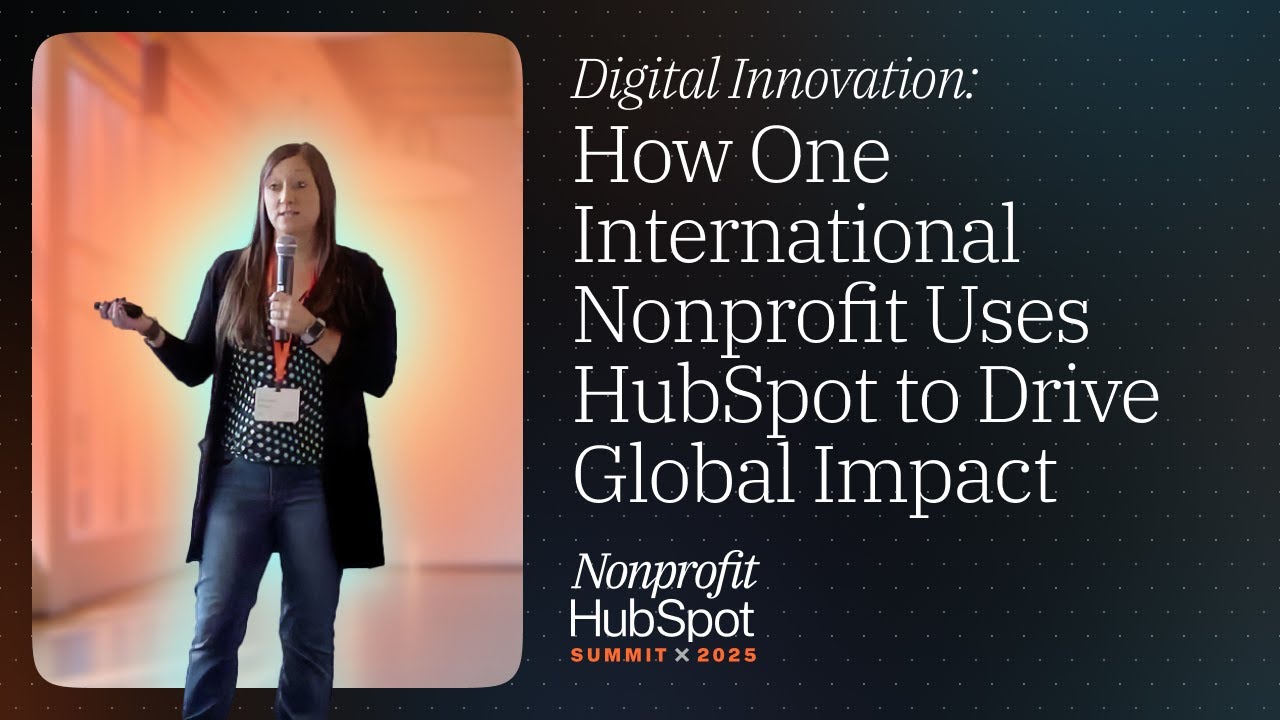
Digital Innovation: How One International Nonprofit Uses HubSpot to Drive Global Impact
Conference presentation by Heather Huegi, Senior Manager of Digital Marketing and Technology at the International Fund for Animal Welfare (IFAW)
IFAW's digital marketing team was using a powerful but complex marketing platform that required technical expertise the team didn't have, making it difficult to execute the personalized, multi-market strategies the organization needed. Heather Huegi shares how IFAW made the case for change, transitioned from Salesforce Marketing Cloud to HubSpot, and built a more flexible marketing operation that increased productivity, expanded personalization, and supported growth across eight international fundraising markets.
About IFAW
The International Fund for Animal Welfare (IFAW) was established in 1969 and has grown from its origins fighting the Canadian seal hunt into a global nonprofit working in more than 40 countries. The organization focuses on rescuing, rehabilitating, and releasing animals; responding to disasters; addressing wildlife crime and trafficking; restoring and protecting natural habitats; and partnering with communities, governments, and other organizations to create a world where animals and people can thrive together.
Heather Huegi has worked in digital marketing for approximately 16 years, with experience in higher education, market research, a biopharma conference company, and a digital agency that was a HubSpot partner. She joined IFAW about four years ago and describes technology as a major part of her work, particularly using it to help organizations achieve their digital goals. At IFAW, she saw an opportunity to use technology more effectively to increase productivity, improve personalization, and support revenue growth globally.
The Challenge: A Powerful Platform That Wasn't Working for a Lean Team
When Heather joined IFAW, the organization was using Salesforce Marketing Cloud for email campaigns, basic welcome journeys, digital advertising audiences, and SMS. The platform was robust and flexible, but it required a level of developer expertise that IFAW's team didn't have. There were no internal developers dedicated to external programs, and building even relatively simple journeys could require SQL knowledge. The platform was also a collection of acquired tools rather than a system purpose-built around marketing automation, and the team's workflows had become convoluted and difficult to manage.
The system had originally been recommended by an external consultant seven years earlier, for a very different digital team and a very different digital landscape. Over time, Marketing Cloud had essentially become a "set it and forget it" tool. It continued doing what it had been configured to do, but there was little reporting, innovation, or internal investment. The result was an increasingly inefficient marketing operation. Heather and a colleague spent months learning enough SQL to work with the system, time that was supposed to be spent doing marketing. IFAW also hired an external vendor for support, but that support was expensive and limited, leaving the team still struggling to execute its work in a timely way.
At the same time, expectations for the team were increasing. IFAW needed sophisticated donor journeys, personalized strategies and content, complex reporting, and more revenue and advocacy across eight fundraising markets. The organization operates internationally, including markets such as France, Germany, the Netherlands, Australia, Canada, and the United States, which meant working across multiple languages, markets, and GDPR requirements. The team was being asked to personalize more, move faster, and accomplish more without changing its structure. Heather ultimately concluded that the existing technology was setting the team up for failure.
Why HubSpot?
Getting approval to make the change wasn't easy. Heather faced concerns that HubSpot wasn't built for nonprofits, that a technology transition would take too much time and investment, and that leadership wouldn't want to replace Marketing Cloud after investing heavily in it only a few years earlier. There was also uncertainty about what HubSpot had become as a platform and whether it could support IFAW's complexity.
Rather than simply arguing for HubSpot, Heather and a colleague built a detailed business case. They evaluated alternatives including Engaging Networks and Raiser's Edge, created pros-and-cons comparisons, and presented the options to leadership. Heather had used HubSpot for approximately 12 years and felt confident in its capabilities, but she wanted to make sure IFAW was doing its due diligence and considering the broader technology landscape.
The case for HubSpot centered on several practical advantages:
- Speed and simplicity: Tasks that could take days or weeks in Marketing Cloud could potentially be completed in minutes or hours.
- Flexibility and usability: The team needed a platform that digital marketers could actually use without relying on specialized developer expertise.
- Personalization: HubSpot's smart content tools could support the increasingly personalized experiences IFAW wanted to provide.
- Donor journeys: Drag-and-drop tools would make it easier to build and modify donor journeys.
- Innovation and scalability: Heather wanted a platform that could grow with the organization and give the team access to new capabilities over time.
- Productivity and time savings: A simpler system would allow the team to spend more time on strategic initiatives rather than learning how to operate the technology.
- Supporter experience: IFAW wanted to better understand donors and provide them with more relevant, connected experiences.
The combination of these factors gave Heather a case she could bring to leadership: the change wasn't simply about replacing one technology with another. It was about giving a lean team the ability to accomplish the work the organization was already asking it to do.
Implementation: Moving Without Losing Momentum
Once the change was approved, Heather had to figure out how to implement HubSpot without adding team members or changing roles. She was confident that the team could learn and use HubSpot, but they didn't have the capacity to handle the implementation themselves. IFAW brought in CauseMic to support the transition, including backend styling, brand guidelines, translations, data synchronization, and the integration between HubSpot and IFAW's other systems.
The project began with a discovery and planning phase in May, during which the team examined what had already been built in Marketing Cloud, what needed to be replicated, and what could be improved in the future. Implementation began the following month, including building templates, establishing data flows, and migrating the workflows IFAW needed. The team focused first on the core functions it had been using in Marketing Cloud: email, donor journeys, advertising audiences, and SMS.
Because there was still concern about whether the transition would work, IFAW kept Marketing Cloud running in parallel for six months. This allowed the team to continue sending emails through the existing platform while HubSpot was being built and tested. Heather had estimated that the transition would take six months, but the U.S. market was fully transitioned in four months. The other international markets followed two months later, putting the organization on HubSpot across all of its markets within six months.
Testing was particularly important because of IFAW's international structure. Regional teams needed to participate to make sure translations were accurate and that regional requirements were being handled correctly. IFAW built the U.S. version first and used it as the foundation for the other markets, then adapted the structure for each region.
How IFAW Uses HubSpot
Today, IFAW uses HubSpot for email campaigns across its international markets, including cultivation, fundraising, and advocacy. The organization also migrated its lead-generation forms, including forms for people requesting information about legacy giving or major-donor opportunities. Landing pages became another important use case because IFAW's custom CMS made it difficult for the team to make quick changes. HubSpot landing pages provided a simpler alternative.
The team also uses A/B testing, targeted workflows, SMS, calls to action, digital advertising, and reporting. Where IFAW previously had one welcome workflow for each market, the organization now has six or seven workflows per market depending on how people enter the system and what they're interested in. SMS has also become more useful because the team can personalize messages much like it does email, combining stewardship and fundraising communications.
The transition has also given the team greater access to reporting and the ability to make decisions more quickly at the individual-market level. Rather than spending significant amounts of time figuring out how to use the technology, the team can spend more time examining the information the technology provides and using it to improve its work.
Supporting Eight International Markets
One of the biggest implementation challenges was creating a system that could support multiple international markets while still giving regional teams enough flexibility to work in ways that made sense for their audiences. IFAW needed to maintain consistency and compliance without forcing every market to follow the U.S. model.
Working with CauseMic, the team created templates and modular structures for emails, forms, and landing pages. Each market could use the same basic structure while swapping out modules, links, footers, translations, and other regional elements. A Netherlands email, for example, could use the same underlying structure as the U.S. version while directing links and footers to the Netherlands office and website.
Smart content and smart lists allow IFAW to personalize communications even within individual markets. In the Netherlands, for example, the organization has fewer mid-level donors but more potential legacy donors, so the team can use smart content to tailor communications to those audiences. Rather than building each variation from scratch, the team can clone an existing structure and swap modules, reducing work that previously could have taken substantially longer.
The same approach extends to forms and landing pages. IFAW recently used HubSpot forms to create a supporter survey about what people wanted to hear about and how often they wanted to be contacted. The forms could be translated and adapted for different markets, while the team retained the ability to make changes themselves. Across its email program, IFAW uses smart content to target different audiences, including mid-level donors, sustainers, lapsed donors, and current donors.
Results: More Productivity, More Personalization, and Lower Costs
The transition produced measurable changes in how much the team could accomplish. IFAW reports a 48% increase in productivity, allowing the team to continue growing revenue while also taking on more strategic work. During one year-end fundraising period, three people produced 80 donation forms and 96 variations of emails in two weeks.
That increase in efficiency created capacity for other work. Instead of spending all of its time building campaigns, the team could explore SMS, digital advertising, and new ways to support internal teams such as donor relations. The technology wasn't simply helping the team do the same work faster; it was creating room to do more of the work the organization needed.
The transition also produced significant cost savings. IFAW estimates that switching from Marketing Cloud to HubSpot saved approximately $110,000 per year. SMS revenue increased by 181% following the transition, although Heather emphasized that other factors also contribute to that result, including what content is sent, when it is sent, and who receives it.
Overall, IFAW is producing approximately three times more content and segmentation than it was previously. The team has expanded the number of workflows it can use to target audiences and move them through the donor journey. Heather described the change as invaluable for the team, which was enthusiastic about the new system once it was in place.
What's Next for IFAW?
Although IFAW has already expanded its use of HubSpot significantly, Heather sees the current implementation as only the beginning. One major area of interest is HubSpot CMS. IFAW's existing CMS requires the organization to work through a vendor for relatively simple website changes, such as adding a button or embed code. With a website manager supporting eight markets, each of which has different needs, the team is exploring whether HubSpot CMS could make the website easier to manage while providing greater flexibility and personalization.
The organization is also exploring social media integration to create more holistic campaign reporting, personalized website and blog content, and A/B testing of website pages. Chatbots are another area of interest, particularly as a way to help website visitors find the right information or connect with the appropriate person on the donor relations team.
AI is also being explored, including HubSpot's Breeze AI tools, although IFAW did not yet have approval to use AI at the time of the presentation. Heather said the organization is in the discovery phase and is considering how AI could support productivity and implementation while maintaining appropriate human oversight.
Audience Q&A
What surprised you most about leading the digital transformation and getting buy-in for HubSpot?
One of the biggest challenges was adapting the case for a nonprofit environment. Heather had previously worked at a digital agency where it was easier to talk about SQLs, MQLs, and traditional marketing funnels. At IFAW, there were more internal structures and more people who needed to be involved in the decision. She had to develop different ways of explaining why HubSpot would be valuable to different audiences and tailor the case to the people whose support was needed.
The process took almost a year, which Heather described as relatively fast for IFAW. She continued advocating for the change and connected the technology decision directly to what the team was being asked to accomplish. Her approach was essentially: if the organization wanted the team to deliver those outcomes, the team needed the right tools to do it.
How did you measure the 48% increase in productivity?
Heather used project-management data to compare what the team had been able to accomplish with Salesforce Marketing Cloud against what it could accomplish with HubSpot. The comparison included the number of email campaigns, workflows, and other tasks the team was completing during comparable periods.
The broader lesson was that tracking time and effort can also help organizations understand the true cost of their marketing activities. Knowing how much time it takes to create a landing page, email campaign, or campaign for a particular audience can become an important part of evaluating effort and return on investment.
How is IFAW thinking about AI without losing the human element?
Heather said this is an important concern for IFAW, particularly because the organization values the human relationships between donors and the organization. The AI applications they are considering would be supplemental rather than replacements for human interaction. For example, AI could help create an email subject line or make certain processes faster, while people would continue overseeing the work.
Heather emphasized that AI should not simply be implemented and left to operate without oversight. IFAW is exploring the processes and policies it would need before moving forward. She gave the example of a chatbot used at a previous agency: it could help determine why someone was visiting the website and direct them toward useful information, but at a certain point the visitor still needed to connect with a person.
How did you communicate the technology transition internally?
IFAW uses a monthly global call where teams share small wins and accomplishments across the organization. Heather's team uses those opportunities to communicate what they have accomplished, including significant outcomes such as the $110,000 in annual savings. Her manager also regularly recognizes the team's work, and internal channels provide additional opportunities for sharing accomplishments and giving kudos.
Heather said communication was especially important during technology transitions because people can be hesitant about change. IFAW tried to communicate not only what was changing but why the change mattered and how it would work.
How did the team manage the workload during the transition?
The transition was challenging because the team still had to meet its normal day-to-day responsibilities. Heather tried to be open with the team about workload and encouraged people to speak up if they were becoming overloaded. The organization also built some flexibility into its timeline: Heather estimated six months for the transition, while her manager estimated a year, providing additional room if the work took longer than expected.
CauseMic effectively became an extension of IFAW's team during the transition. That flexibility was particularly important when unexpected work arose, such as disaster-response fundraising campaigns that required the team to drop other priorities and move quickly. Having an external implementation partner and some additional time built into the plan made it possible to keep the transition moving while responding to those competing demands.
Closing
IFAW's move from Salesforce Marketing Cloud to HubSpot was driven by a practical mismatch between what the organization needed its lean digital team to accomplish and what its existing technology allowed that team to do efficiently. By building a detailed case for change, evaluating alternatives, bringing in implementation support, and designing a structure that could accommodate eight international markets, IFAW was able to transition platforms while continuing its fundraising work. The results included increased productivity, greater personalization and segmentation, significant cost savings, and additional capacity for the team to pursue new digital opportunities.
This transcript has been lightly edited using AI for clarity and readability, with filler language and audience Q&A introductions removed.
 Watch now about From Tech Spaghetti to Scalable Growth: Transforming Nonprofit Marketing with HubSpot
 Watch now about Understanding Attribution: Unlock Your Marketing Insights with HubSpot Revenue Attribution
 Watch now about Making Moments Matter: How Nonprofits can Harness the Power of Earned Media
 Watch now about Granting Capacity, Time, and Impact: Building Your Business Case for a CRM Transformation
 Watch now about Paving the Path to Give: Reducing Donation Form Friction with Fundraise Up
 Watch now about Making Moments Matter: How Nonprofits can Harness the Power of Earned Media