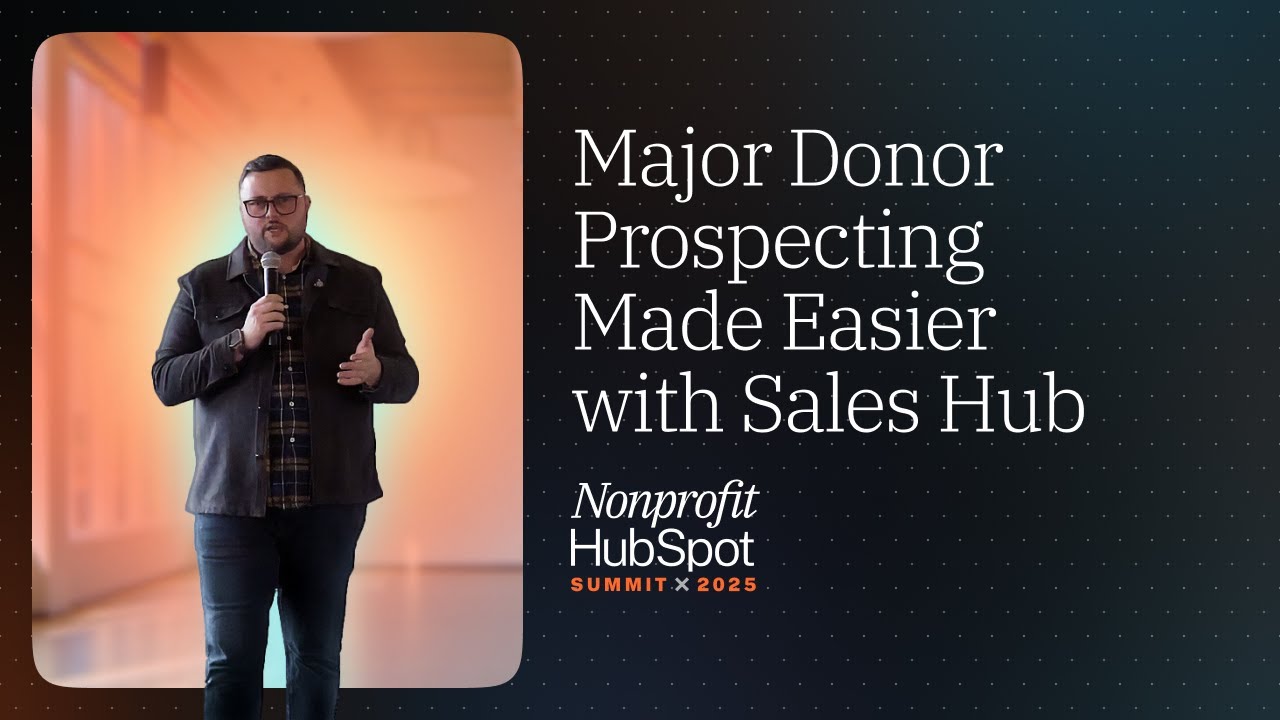
Donors increasingly expect the same seamless, personalized experiences they get outside the nonprofit industry. That means moving away from “spray and pray” appeals and toward personalized experiences, smarter use of AI and automation, and closer alignment between fundraising and marketing
Mass appeals and disconnected systems often make it harder for fundraising and development teams to identify the right prospects and build meaningful relationships at scale. Matt Scott, CEO of CauseMic, walks through how nonprofits can apply modern sales practices and HubSpot Sales Hub to prioritize donors, personalize outreach, automate routine tasks, and give fundraisers better visibility into where their time can generate the strongest returns.
Meet the Speaker
-

Matt Scott
Cofounder and CEO, CauseMic
Matt is a leader in nonprofit growth and a social entrepreneur. Prior to cofounding CauseMic, he led development operations at Team Rubicon, a disaster relief organization whose annual revenue scaled from $275K to $51M during his tenure. Matt is a sought-after speaker, sharing his approach to leadership and social impact at conferences like Dreamforce and the Nonprofit Technology Conference. His commitment to using business for good has been recognized with the Civil Service Award, the Arete Service Award, and the Riordan Service Award.
Chapters
Transcript
Major Donor Prospecting Made Easier with Sales Hub
Conference presentation by Matt Scott, cofounder and CEO at CauseMic
Matt opens by explaining that his work is driven by finding what is actually working in technology and fundraising, both within nonprofits and in the for-profit world, and adapting those practices to help organizations increase their impact. He has spent the last 11 years at CauseMic helping nonprofits select and implement best-in-class technology. Before CauseMic, he led fundraising at Team Rubicon, where the organization grew from approximately $275,000 to $51 million in annual revenue over seven years. His interest in applying for-profit technology to nonprofit fundraising began at Team Rubicon, when he saw how companies such as Chewy used Salesforce to create personalized experiences at scale. That experience led his team to think differently about how technology could make donors feel recognized and engaged, and eventually helped Team Rubicon scale from roughly $750,000 to $3.5 million in revenue over a year.
Sales Is Evolving
The sales environment is changing quickly, and nonprofits need to keep pace because donors increasingly expect the same kinds of seamless, personalized experiences they receive from for-profit companies. Matt points to Amazon's one-click checkout as an example of the experience donors have come to expect. At the same time, mass appeals and "spray and pray" communications are becoming less effective. Rather than simply reaching more people, organizations need to connect with the right people and use donor data and segmentation to deliver messages that are relevant to their interests.
The donor is also increasingly in control of the experience. Organizations need to create ways for supporters to communicate what they care about and then use that information to serve them content that matters. AI and automation are another major part of this shift. Matt argues that these tools can help sales teams determine where to focus their time and effort, and that nonprofits should be seriously considering how they can use AI to make their teams more efficient. Finally, fundraising and marketing need to be closely aligned. Teams should be talking regularly about which stories and content are moving donors, what frontline fundraisers are hearing, and what is motivating people to give.
HubSpot Can Help Nonprofits Adopt These Best Practices
HubSpot can help organizations put many of these practices into place, but technology alone isn't enough. Organizations also need to change how they work so they can take advantage of an integrated technology ecosystem rather than continuing to operate in disconnected silos. Matt introduces a fictional major gift officer, Laura, to demonstrate what that can look like in practice. Laura manages a portfolio of approximately 150 major donors who give $10,000 or more, but in the old model, she struggled to keep track of donor activity, understand who was interested in the organization, and prevent her major donors from receiving generic marketing appeals. Recording relationship activity was cumbersome enough that she eventually stopped entering information into the system and kept it in a notebook instead.
Building a More Intelligent Major-Donor Workflow
With HubSpot, Laura's workflow begins several weeks before a trip to New York. She identifies warm leads who are already engaging with the organization's content and enrolls them in a sequence inviting them to meet while she is in town. Six people respond positively enough to become meetings—four donors and two prospects. HubSpot also gives Laura a clearer picture of what each person has been doing. For example, one prospect, Jack, has attended a program call, visited the planned giving page, and demonstrated interest in particular areas of the organization's work. Those signals improve his lead score and give Laura additional context for her conversation.
The system can also surface information that helps Laura prepare strategically. She sees that Jack works for Microsoft and that Microsoft offers a matching-gift program, giving her another potential avenue for the conversation. Because the six prospects are enrolled in the sequence, Laura's colleague Mary receives tasks to conduct deeper prospect research. HubSpot's prospecting workspace helps the team identify who needs attention and what tasks need to be completed, rather than requiring staff to determine manually where to spend their time.
Automating the Details Around the Relationship
As Laura's trip approaches, the sequence handles routine communications while still making the experience personal. Jack receives a text about legislation affecting public access to Rockaway Beach, an issue connected to a previous conversation and his interests. Meeting confirmations and reminder texts are sent automatically. Deeper prospect research also reveals that Jack recently had a baby, allowing Laura to bring a personalized gift and card to the meeting. The automation handles the logistical work while giving Laura better information to make the actual relationship-building conversation more meaningful.
During the trip, Laura can continue managing the relationship from the HubSpot mobile app. After her meeting with Jack, she creates the donation opportunity, records notes about their conversation, schedules follow-up, and assigns a task to Mary to send a handwritten card. Instead of writing everything down and hoping it makes its way back into the system later, she can capture the information while she is on the go. HubSpot's Gmail integration also allows her to send follow-up messages using team templates, schedule meetings, create tasks, and track activity without leaving Gmail.
Connecting Fundraising and Marketing
The team also uses a monthly prospecting meeting to bring fundraising and marketing together. They review open donations and discuss what can be done to move each opportunity forward—from initial interest to a commitment, pledge, and ultimately a completed donation. As opportunities move through the pipeline, HubSpot can trigger sequences, tasks, and other actions based on the stage. Matt notes that HubSpot is also developing the ability to rename objects such as "deals" so that nonprofits can use terminology that better reflects their fundraising processes.
Six weeks after Laura's New York trip, she reaches out to Jack to request a $115,000 contribution and reminds him that Microsoft offers a matching gift. The integrated fundraising experience makes it easier for Jack to complete the contribution and potentially increase its impact through the matching program. The broader point is that technology can support the entire relationship—not simply the final donation request—by connecting research, communication, meetings, follow-up, and giving activity.
Using AI and Automation to Focus Fundraiser Time
Not every prospect will continue to engage. Twelve weeks later, Laura sees that two of the people she met in New York have stopped responding and are no longer engaging with her communications. Rather than continuing to spend valuable one-to-one fundraising time on them, she can disqualify them from her active pipeline and enroll them in a re-engagement sequence that will begin six months later. In the meantime, they can continue receiving appropriate programmatic communications from the marketing team.
This approach allows the fundraiser to maintain a larger portfolio without treating every contact as though they require the same level of attention. AI, automation, and HubSpot's sales tools can help identify who is showing meaningful engagement and who should receive attention today. The goal isn't to automate the relationship itself; it is to automate the administrative and lower-priority work so the fundraiser has more capacity for the people who are ready for a deeper relationship. In Matt's example, Laura isn't simply managing transactions—she is building lasting, personalized relationships with donors based on where each person is in their journey.
Audience Q&A
How can nonprofits identify matching-gift opportunities?
Matt recommends using a matching-gift tool that maintains data on employers, match amounts, and eligibility. He discusses Fundraise Up's matching-gift functionality, which can surface matching information during the donation process and automatically populate relevant information based on the donor's domain.
How does a major donor typically enter this kind of personalized fundraising workflow?
In Matt's experience, major donors rarely go directly from being completely new contacts in the database to becoming part of a major-donor portfolio. More often, they are already subscribed to the organization's content and have an existing relationship with the organization. A major gift officer may then ask marketing to pause broad marketing communications for a particular donor while the fundraiser provides more personalized updates directly.
How should nonprofits approach prospects who have not opted into communications?
Matt distinguishes between existing subscribers who are being moved into a more personalized relationship and completely new prospects. Organizations should not simply subscribe people to marketing communications without their permission. For prospective corporate partners, he recommends prioritizing organizations based on brand or mission alignment and using direct outreach—such as LinkedIn Sales Navigator or email—to begin the relationship. Once there is an actual conversation, the fundraiser can ask whether the prospect would like to receive the organization's newsletter or other content and record that permission.
Closing
The central idea is to borrow useful practices from modern sales organizations without losing what makes nonprofit fundraising different: relationships and mission. HubSpot Sales Hub, AI, and automation can help fundraisers identify where to focus, reduce administrative work, coordinate with marketing, and personalize interactions at scale. Used thoughtfully, the technology gives fundraisers more capacity to spend their time where it matters most—building meaningful relationships with the people who care about the organization's mission.
This transcript has been lightly edited using AI for clarity and readability. Filler language, repeated phrases, audience chatter, and transcript artifacts have been removed while preserving the speaker's examples, terminology, and key points.
-
 Watch now about From Tech Spaghetti to Scalable Growth: Transforming Nonprofit Marketing with HubSpot
From Tech Spaghetti to Scalable Growth: Transforming Nonprofit Marketing with HubSpot
Justus Hyatt, Marketing Director at Thorn, shares how HubSpot helped transform their marketing strategy, from outdated systems to scalable growth, at the Nonprofit HubSpot Summit. Learn more about the Nonprofit HubSpot Summit, an event to give ...
-
 Watch now about Digital Innovation for Nonprofits: Using HubSpot to Drive Global Impact
Digital Innovation for Nonprofits: Using HubSpot to Drive Global Impact
Discover how Heather Huegi, Senior Manager of Digital Marketing and Technology at the International Fund for Animal Welfare (IFAW), is using HubSpot to innovate and scale nonprofit efforts worldwide, as shared at the Nonprofit HubSpot Summit.
-
 Watch now about Understanding Attribution: Unlock Your Marketing Insights with HubSpot Revenue Attribution
Understanding Attribution: Unlock Your Marketing Insights with HubSpot Revenue Attribution
HubSpot’s attribution reporting tools can enable nonprofits to track, optimize, and boost marketing revenue. Watch Erin Cavender-Sharma, CauseMic’s Digital Marketing Strategist explain the tools and methodologies at the Nonprofit HubSpot Summit.
-
 Watch now about Granting Capacity, Time, and Impact: Building Your Business Case for a CRM Transformation
Granting Capacity, Time, and Impact: Building Your Business Case for a CRM Transformation
Abby Guyer from Xcelerate Women and Adrienne Chaille from Washington County Economic Development share their unique story as a capacity grant recipient and provider. They discuss the process of securing funding for CRM investment and how HubSpot played ...
-
 Watch now about Paving the Path to Give: Reducing Donation Form Friction with Fundraise Up
Paving the Path to Give: Reducing Donation Form Friction with Fundraise Up
Sal Salpietro explains the "Friction Tolerance Threshold" and how it can help nonprofits reduce donor friction and boost engagement. He discusses how to optimize donation forms, personalize donor experiences, and increase conversions without a big budget ...
-
 Watch now about Making Moments Matter: How Nonprofits can Harness the Power of Earned Media
Making Moments Matter: How Nonprofits can Harness the Power of Earned Media
Jessica Bryant from Save the Children Canada explains how nonprofits can harness earned media to boost engagement, build trust, and drive impact. She discusses strategies for effective media engagement during her talk at the Nonprofit HubSpot Summit.